Executive summary
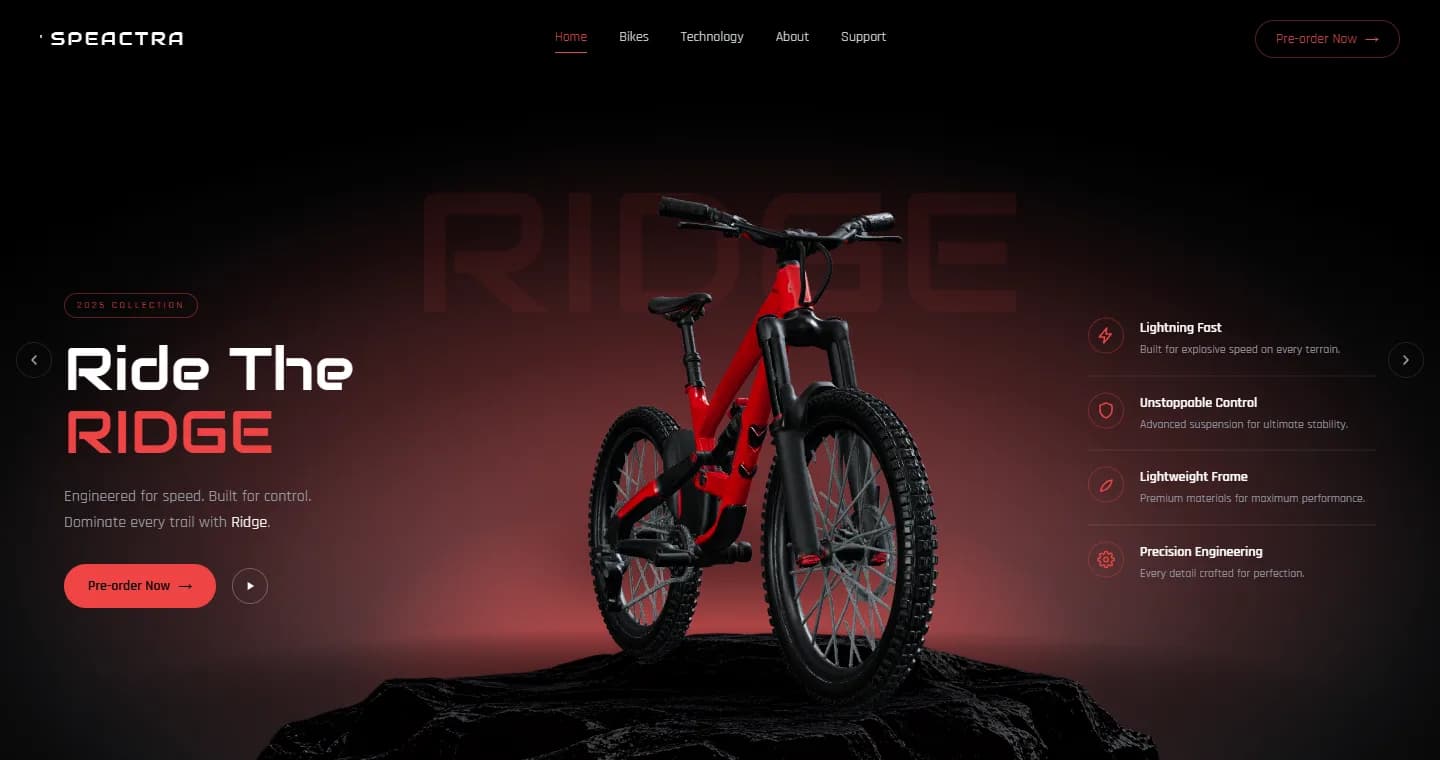
Cycle 3D is a ShubhDigi concept project — an interactive 3D product showcase, not a documented paid-client rollout. The live demo at cycle-3d.vercel.app presents “Speactra” and the Ridge bicycle as a real-time WebGL experience: a canvas-rendered bike, scroll-driven product storytelling, specification modules, and a Pre-order Now call to action.
This case study is for product teams who want an interactive 3D product website rather than a static brochure. Verified runtime evidence includes React 19, Three.js, WebGL, a GLTF/DRACO loading path, and a Vite-built bundle hosted on Vercel. React Three Fiber and GSAP are not claimed because they were not clearly identified in the public bundle.
Related services: web application development and website development.
Brand and business context
The demo brands the bicycle as Ridge inside the Speactra 2025 collection. On-page copy emphasises trail performance: wheel size, travel, weight, drivetrain, motor power, and torque. Navigation labels — Home, Bikes, Technology, About, Support, Pre-order Now — mimic a product-launch marketing site.
Because the host is a Vercel app URL and no independent manufacturer confirmation is attached to this write-up, the project is labeled an interactive 3D showcase / concept. Spec numbers on the page (for example 29" wheels, 160mm travel, 13.2kg) are part of the demo narrative, not audited engineering data from a shipping product line.
Project requirements
An immersive bicycle site has to do jobs a photograph grid cannot:
- Let people inspect form and silhouette in three dimensions
- Move the camera or scroll the story without losing the product
- Surface performance specs without dumping a PDF
- Remain usable on a phone, where WebGL budgets are tighter
- Offer a next step (here, Pre-order Now)
Those requirements frame the concept. No pre-existing website audit was available.
Goals
- Put a real-time 3D bicycle at the centre of the first screen.
- Use scroll and section storytelling to reveal engineering claims.
- Provide bike-to-bike controls where the UI exposes previous/next actions.
- Keep a marketing shell (nav, pre-order) around the canvas.
- Ship as a modern React + WebGL bundle on a global host.
Strategy and approach
The approach is product-as-scene. Instead of a hero photograph, the homepage canvas holds the Ridge model. Surrounding UI — collection label, headline, feature tiles, and specification readouts — annotates what the camera is showing. Scroll moves the visitor through performance, drivetrain, frame, and support chapters.
Loading strategy is visible in the runtime: the captured experience showed a progress indicator (100%) before interaction, and the bundle registers DRACO and GLTF loaders. That is the honest version of “we thought about payload” — compressed 3D assets — without inventing a Lighthouse number.
Fallbacks are limited in the public capture: a single canvas is present. Teams commissioning a production 3D site should still plan a static image fallback for older devices; this concept’s public page is the WebGL path.
Information architecture and user journey
The demo behaves as a one-page product story with in-page sections rather than a large multi-route catalogue.
Visitor path:
- Land on the 3D Ridge hero with Pre-order Now.
- Read feature tiles (speed, control, weight, engineering).
- Scroll into numeric specs and motor/drivetrain chapters.
- Continue into “under the hood” and support copy.
- End on a second Pre-order Now.
Buttons captured on the live page include previous/next bike, a like control, and a mobile menu toggle. There is no separate checkout URL in the capture — pre-order is a marketing CTA inside the experience.
UI/UX and visual direction
The interface is dark, high-contrast, and product-first. Typography treats the bike name as a poster headline (“Ride The RIDGE”). Spec callouts use large numerals so the 3D scene is not the only information channel.
Motion is the point of the piece: camera and model presence change as the visitor explores. The UI keeps chrome thin so the canvas remains the stage. Mobile uses a toggle menu because a full desktop nav would crowd the WebGL view.
Development and technical implementation
Verified from the public HTML and JavaScript bundle captured on 19 September 2026:
- React 19.2.0 reconciler identifiers in the bundle
- Three.js materials, WebGLRenderer / WebGLProgram paths, and shader materials
- WebGL canvas (one canvas element on the homepage)
- GLTF + DRACO loaders for compressed 3D assets
- Vite-style hashed bundle at
/assets/index-*.js - Vercel hosting at cycle-3d.vercel.app
Not claimed: React Three Fiber, Drei, GSAP, a production CMS, payment integration, or measured frame-rate SLAs.
Important features delivered
- Real-time 3D bicycle hero on a WebGL canvas
- Scroll-driven product storytelling around the model
- Specification modules (geometry, motor, drivetrain, weight)
- Previous / next bike controls
- Marketing nav and Pre-order Now CTAs
- Mobile menu for the same sections
- Compressed 3D loading via DRACO/GLTF
- Progress state before the scene is ready
Responsive experience
Desktop (~1440×900) gives the canvas room beside headlines and spec columns. Mobile (~390×844) stacks the story and uses a toggle menu so the 3D view is not covered by a persistent desktop nav. Interaction still depends on device GPU; the concept does not publish a guaranteed mobile frame rate.
SEO, performance, accessibility, and discoverability
Public observations:
- Document title is the demo brand name “Speactra”
- Viewport meta is present
- No JSON-LD was present on the captured homepage
- Canvas content is inherently harder for crawlers than HTML product copy — the surrounding spec text is what remains indexable
- Toggle menu uses an accessible label (“Toggle menu”)
- Like / previous / next controls expose aria-labels
A production launch would still need unique meta, a self-canonical, and richer HTML alternatives for the 3D scene. Those extras are not invented here.
Outcome
Cycle 3D demonstrates that ShubhDigi can ship an immersive, scroll-told bicycle experience in the browser using React, Three.js, and WebGL — with compressed assets and a marketing shell. It is a concept showcase for interactive product storytelling, not a case study of sales lift.
If you want an interactive 3D product experience, start a conversation.
Key takeaways
- Label concept and demo work clearly; this project is hosted on a Vercel app URL.
- Three.js + WebGL + React are verified; fashionable extra libraries are not assumed.
- Scroll and spec modules keep a 3D site readable when the canvas is not interactive (or not crawlable).
- Loading progress and DRACO/GLTF compression are part of the delivery, not decoration.
- Accessibility labels on 3D chrome still matter.
Sources and verification
Live demo https://cycle-3d.vercel.app/ inspected on 19–20 September 2026, including homepage HTML, canvas count, and the public JS bundle. Technology claims are limited to strings and constructors found in that bundle.